BaaS & Financial Settlement Data Sink
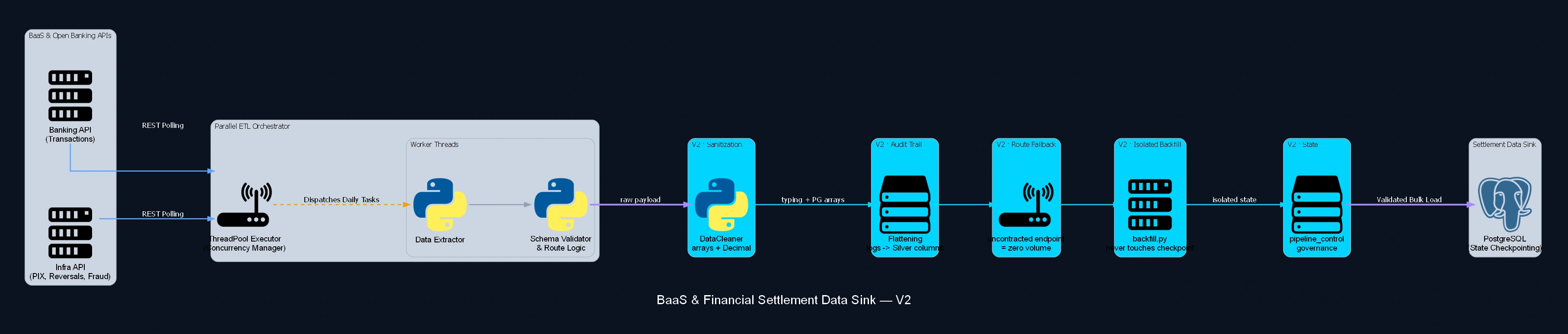
Financial settlement data scattered across multiple banks (Banking-as-a-Service), centralized by a programmatic integration pipeline that orchestrates the capture of thousands of payments and converts them into immutable records in the Data Warehouse, with corporate authentication via Azure Active Directory and tokens. Before any native PostgreSQL COPY, every load passes through a dedicated sanitization layer; a flattening engine turns nested logs into audit columns queryable directly, with no join; and the historical backfill script runs isolated from the production checkpoint, with no risk of reprocessing or corrupting the incremental in progress.


Case Study
Problem
Financial payloads arrived with native lists that broke PostgreSQL's bulk loader. Transaction logs in a normalized table only answered through slow joins, and lost the exact snapshot of the moment the operation happened. And running a retroactive historical load risked overwriting the production pipeline's checkpoint, trapping it in a loop.
Solution
Before any COPY, a dedicated sanitization engine converts every list into Postgres's native array format. At the Silver layer, flattening is total: the transformer opens the nested payload and writes its columns, already prefixed, straight into the log table, so an audit becomes a single SELECT. The backfill script is fully passive, never writes to the production checkpoint, and every extractor treats an uncontracted endpoint as zero volume without bringing down the rest of the pipeline.
Impact
Continuous ingestion of high-criticality settlement data with no risk of corrupting production state. An immutable audit trail, queryable directly, with no join. Resilient to a partially contracted product, with no manual intervention.
Need to centralize multi-bank settlement data into one pipeline? Let's design that integration for your context.
Discuss your case